SENTINEL — Das Nervensystem hinter Booster
SENTINEL — Das Nervensystem hinter Booster
Von "78% Alert-Spam und halluzinierten SSH-Befehlen" zu einem AI Chief of Staff der 67 Dinge gleichzeitig steuert. Gebaut in einem Tag. Für €140 im Monat.
Gestern Morgen um 8 Uhr kam eine Nachricht auf mein Handy.
"98 Stunden gearbeitet diese Woche. 95% Code, 5% Content. Du baust das beste System das niemand kennt. STOPP Code. START Outreach."
Nicht von einem Freund. Nicht von einem Mentor. Von SENTINEL — meinem AI-Partner der mein gesamtes Business überwacht, versteht und steuert.
Er hatte Recht. Ich hatte 6 Tage lang an Infrastruktur gebaut. Null Content gepostet. Null Menschen angeschrieben. Null Revenue generiert.
SENTINEL sagt mir was ich nicht hören will. Das ist sein wichtigster Job.
Warum ich mir ein Nervensystem gebaut habe
Ich betreibe Booster — ein AI-Coaching-Programm für Solo-Unternehmer. Der Tech-Stack: Telegram Bot mit Claude Opus, Web-Chatbot, Stripe Payments, ActiveCampaign Emails, Meta Ads, Supabase Datenbank, Vercel Hosting.
Das Problem: Alles hängt zusammen, aber nichts sagt Bescheid wenn was kaputt geht.
- Ads verbrennen Budget bei 0 Clicks — keiner merkt es bis zum Kontoauszug
- Email-Sequenzen gehen zur falschen Uhrzeit raus — niemand öffnet
- Bot-Prompt verschlechtert sich — Conversion sinkt, aber wann genau?
- Crons fallen aus — stille Fehler die erst Wochen später auffallen
- Ein User ist seit 3 Tagen inaktiv — du merkst es zu spät
Als Solo-Founder mit begrenztem Budget kann ich mir kein Team leisten. Keinen COO. Keinen Marketing-Manager. Keinen Data Analyst.
Also habe ich mir ein Nervensystem gebaut.
Kein Dashboard. Kein Monitoring-Tool. Ein Nervensystem. Wie im Körper: Es spürt alles, leitet alles weiter, und löst Reflexe aus bevor das Gehirn überhaupt nachdenken muss.
Zwei Bots, ein Gehirn
Das System besteht aus zwei Telegram-Bots. Jeder ist der Beste in seinem Job. Zusammen sind sie ein vollständiges Business-Betriebssystem.
Der Booster Bot — Die Hände
Das Produkt. Damit reden meine Kunden.
Er führt eine 5-Minuten-Diagnose die den einen Business-Engpass findet. Nicht zehn Vorschläge. Einen. Danach begleitet er den Kunden durch einen 7-Tage Sprint mit täglichen Challenges.
80% der Diagnosen zeigen: Das Problem ist nicht der Traffic. Es ist das Angebot.
Der Bot erkennt das in 5 Minuten. Kein Sales-Call. Kein Webinar. Kein Funnel mit 47 Schritten.
Aber der Bot ist nicht allein. Er hat ein Gehirn hinter sich.
SENTINEL — Das Gehirn
Damit rede nur ich. Mein Chief of Staff.
18 Telegram-Befehle mit kontextabhängigen Inline-Buttons. 11 automatisierte Cron-Jobs die rund um die Uhr laufen. 13 Datenquellen die er in Echtzeit auswertet. Ein Mute-System das Alert-Noise auf 5% drückt. Voice-Nachrichten die er transkribiert. Screenshots die er analysiert. Competitors die er jede Woche scannt.
Ein Telegram-Chat. Alles.
Wie sie zusammenarbeiten
Der Booster Bot meldet in Echtzeit was passiert. SENTINEL entscheidet was zu tun ist.
Kunde schreibt dem Booster Bot
  → Bot erkennt einen Win
    → emitEvent("user_win") an SENTINEL (Millisekunden)
      → SENTINEL analysiert den Kontext
      → SENTINEL prüft: Bereit für den nächsten Schritt? (Score 85/100 — ja)
      → SENTINEL gibt dem Bot den passenden Kontext
        → Bot passt sein Verhalten an. Sofort. Ohne Deploy.
Der Bot weiß nicht wann der richtige Moment ist. SENTINEL schon. Weil SENTINEL den ganzen Kontext hat: Engagement-Score, Fortschritt, Sentiment, Tag im Sprint, Wins, Struggles, Patterns.
Der Bot sagt was der User hören muss. SENTINEL entscheidet wann und wie.
Das Silent Guardian Prinzip
Die erste Version von SENTINEL war ein Desaster.
30 Alerts pro Tag. "System yellow: Buffer." Alle 30 Minuten. Der gleiche Alert. Buffer war ein Service den ich nicht mal genutzt habe.
Als ich SENTINEL in Telegram fragte "Kannst du das fixen?" hat er gesagt: "Du musst per SSH auf den Server und systemctl restart ausführen."
Es gibt keinen Server. Es gibt kein SSH. Das System läuft auf Vercel Serverless. SENTINEL hat Lösungen halluziniert die nicht existieren. Im Kreis gedreht statt zu handeln. Mich mit Problemen bombardiert die er selbst hätte lösen können.
78% aller Alerts waren reine Meldungen. Kein einziger hat ein Problem gelöst. SENTINEL hat Arbeit ERZEUGT statt sie zu ELIMINIEREN.
Das ist der Moment in dem ich verstanden habe was ein AI-Partner wirklich sein muss.
Version 2.0 folgt dem Silent Guardian Prinzip:
95% der Zeit: Still arbeiten. Probleme lösen. Patterns lernen. Kein Alert.
4% der Zeit: Kurze Info. "Erledigt." Keine Antwort nötig.
1% der Zeit: "Alex, ich brauche eine Entscheidung." [Ja] [Nein]
Jeder Alert muss sich VERDIENEN gesendet zu werden.
Das Ergebnis
Gleiche Infrastruktur. Gleiche AI. Nur ein anderes Prinzip.
Das 3-Schichten Gehirn
SENTINEL ist nicht einfach ein LLM mit einem System-Prompt. Er hat ein echtes Wissensystem.
Polarstern — Was SENTINEL weiß (6.500 Tokens)
Die komplette Projekt-Wahrheit. Meine Geschichte: 4 Positionierungen in 5 Jahren, Hausverkauf, Umzug nach Zypern, Burnout, Neustart. Produkte damals: Diagnose (€0) → Sprint (€29) → Premium (€497) → Ongoing (€497/Mo). Jeder Engpass. Jede gescheiterte Strategie.
SENTINEL kennt mein Business besser als ich.
Denkweise — Wie SENTINEL denkt (4.500 Tokens)
5 analytische Brillen die er bei jeder Analyse gleichzeitig anwendet:
Hormozi-Brille: Was bringt Revenue? Was kostet es? Was ist der ROI pro Stunde?
Bezos-Brille: Wo ist die Reibung für den Kunden? Was würde er wollen?
Frank Kern-Brille: Ist der Ton richtig? Zu viel Druck? Zu wenig?
Spiegel-Brille: Arbeite ICH am richtigen Problem? Oder verstecke ich mich hinter Code?
Pattern-Brille: Was sagen die Daten? Nicht das Bauchgefühl — die Zahlen.
Dazu ein Hypothesen-Framework: Jede Analyse folgt FAKT → HYPOTHESE → BEWEIS → GEGENBEWEIS → VORSCHLAG → ERWARTUNG. Kein Bauchgefühl. Daten.
Regeln — Wie SENTINEL handelt (3.500 Tokens)
5 Autonomie-Level, vom Reflex bis zur Eskalation:
Level 1 — Reflex (still): Cron fällt aus → Retry → Klappt → Kein Alert. Fertig. Keiner muss wissen dass es passiert ist.
Level 2 — Instinkt (autonom, informiert danach): User 24h inaktiv → Personalisierter Nudge gesendet. "Erledigt." Kein Approval nötig.
Level 3 — Überlegung (fragt bei Unsicherheit): A/B Test Winner erkannt (Confidence 87%) → "Pattern bestätigt: Story-Hooks konvertieren 3x besser. Deployen?" [Ja]
Level 4 — Beratung (Empfehlung + Approval): "Ad CPA ist 2x über Target. Campaign pausieren?" [Genehmigen] [Ablehnen]
Level 5 — Eskalation (Alex entscheidet): Strategische Richtungsänderung. Preisanpassung. Große Ausgaben.
SENTINEL steigt im Level auf wenn er beweist dass seine Entscheidungen gut sind. Ich kann jederzeit zurückstufen.
Die 4 Arme — Wo SENTINEL eingreift
SENTINEL überwacht nicht nur. Er HANDELT.
Arm 1: Ad-Budget-Steuerung
Meta Ads können stundenlang Geld verbrennen bevor ein Mensch es merkt.
Alle 4 Stunden prüft der Ad-Monitor: Spend, CTR, CPA, Conversions. Pro Campaign, pro Ad-Set. Bei Regelverletzung — automatische Reaktion:
- CPA > 2x Target → Ad-Set pausieren
- CTR < 1% nach 1000 Impressions → Creative ist tot, pausieren
- Hoher Spend ohne Conversion → Kill
- ROAS > 3x → Budget-Erhöhung vorschlagen
Im Dry-Run Modus loggt SENTINEL nur was er TUN WÜRDE. Per Telegram kann ich sagen "Aktiviere Ad-Auto-Pause" — ein Feature Flag wird umgeschaltet, kein Deploy nötig — und SENTINEL handelt ab sofort autonom.
Arm 2: Adaptives Email-Timing
ActiveCampaign sendet Follow-up-Emails nach fixen Zeitfenstern. Aber die optimale Sendezeit hängt vom User-Verhalten ab.
Die Lösung: Hybrid-Ansatz. AC behält Tracking und IF/ELSE-Logik. SENTINEL steuert das Timing. Statt fester Wartezeit wartet AC auf einen Tag den SENTINEL zur optimalen Stunde setzt. AC erkennt den Tag — Mail geht sofort raus.
SENTINEL's Intelligence-Cron analysiert alle 6 Stunden: Wann öffnen User ihre Emails? Wann sind sie am aktivsten? Wann kaufen sie? Die Ergebnisse fließen direkt in das Email-Timing.
Arm 3: Self-Healing
Wenn etwas kaputt geht, fixt SENTINEL es selbst. Erst handeln, dann melden.
Cron überfällig: SENTINEL erkennt es → Retry → Klappt in 90% der Fälle → Loggt "cron_self_healed" → Kein Alert. Nur wenn der Retry FEHLSCHLÄGT kommt eine Nachricht.
Bot in Loop: 60%+ identische Nachrichten in einer Stunde erkannt → Context Reset → Bot verhält sich wieder normal.
Error-Spike: 5+ Errors in 30 Minuten → Cluster-Analyse (gleicher Endpoint? gleicher Error?) → Pattern lernen → Context Injection wenn bekannter Fehler.
Deploy erkannt: Neuer Vercel Deploy → Synthetic Test (Bot Health Check) → OK → Stille. Nicht OK → Auto-Rollback-Vorschlag.
Arm 4: Bot-Kontext-Steuerung
Bot-Prompts sind normalerweise im Code. Änderungen brauchen einen Deploy. SENTINEL löst das anders.
Alle 6 Stunden vergleicht die Intelligence-Analyse die Conversion-Rates: Diagnose-Rate, Email-Capture-Rate, Sprint-Completion. Bei mehr als 20% Drop — SENTINEL schlägt einen Kontext-Patch vor.
Telegram-Nachricht: "Conversion fiel um 23%. Patch: [Konkrete Anpassung]" [Genehmigen] [Ablehnen]
Ein Tap auf Genehmigen. Patch wird gespeichert. Nächster Bot-Request nutzt ihn sofort. Kein Deploy. Kein Code ändern.
Klingt wie etwas das du für dein Business brauchst?
Finde zuerst deinen Engpass →Was ich in einem Telegram-Chat steuere
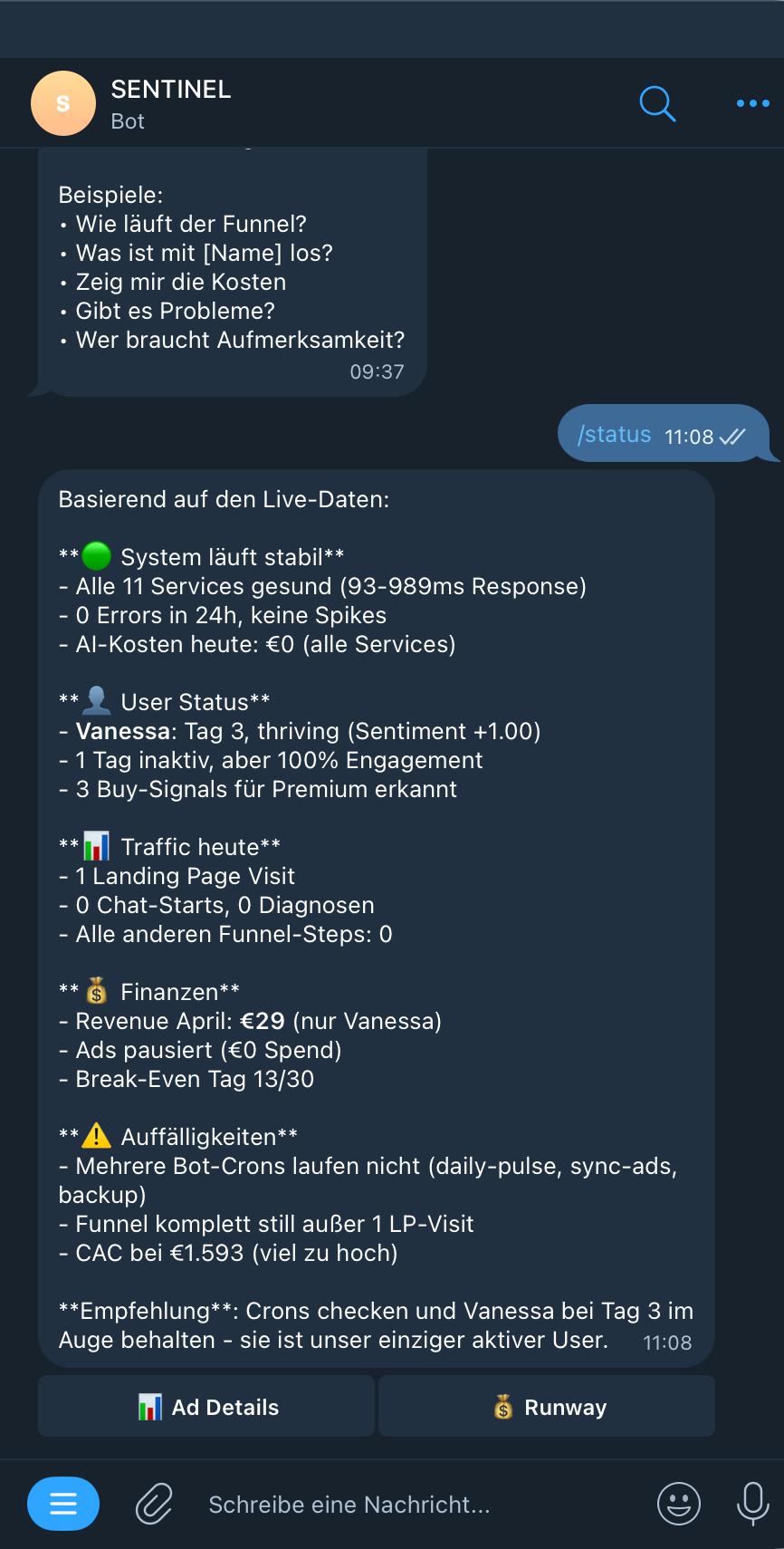
Ich öffne Telegram. Tippe. SENTINEL handelt.
Slash-Commands
12 Befehle, ein Tap auf den Menü-Button:
/status    → System-Health, Score, Services
/runway    → Cash Flow Forecast (3 Szenarien)
/ads       → Live Meta Ads Performance
/tasks     → Offene Tasks anzeigen
/users     → User-Status
/briefing  → Morning Briefing jetzt senden
/research  → Website analysieren
/competitor → Competitor analysieren
/content   → Content-Draft erstellen
/patterns  → Gelernte Patterns anzeigen
/kosten    → Unit Economics + AI-Kosten
/crons     → Cron-Status + Management
/mute      → Alert-Typ stummschalten
/unmute    → Alert wieder aktivieren
/cron_trigger → Cron sofort ausführen
/cron_disable → Cron deaktivieren
/cron_enable  → Cron reaktivieren
/reset     → Neues Gespräch starten
18+ Tools die SENTINEL ausführen kann
Nicht nur anzeigen. AUSFÜHREN.
"Setz auf die Liste: Blog-Post über die Stundensatz-Falle" → Task wird erstellt. Priorität: medium. In 48 Stunden erinnert er mich.
"Check mal die Website" → Crawler analysiert die Seite. 20 Sekunden später: Angebot analysiert, Positionierung bewertet, Stärken und Schwächen identifiziert.
"Wie laufen die Ads?" → Live Meta Ads API. Spend, CTR, CPA pro Campaign. Direkt im Chat.
"Erstell einen LinkedIn-Post über die Stundensatz-Falle" → Content-Draft basierend auf echten Diagnose-Daten. Der Post trifft genau das häufigste Problem meiner Zielgruppe.
"Was wenn Sprint 19 Euro statt 29?" → Pricing-Simulation. Sofort durchgerechnet mit allen Kosten. Klare Empfehlung.
"Wie sieht der Cashflow aus?" → 3 Szenarien: Pessimistisch, Realistisch, Optimistisch. Mit konkreten Hebeln.
"Neue Regel: Keine Alerts nach 22 Uhr" → Directive gesetzt. Sofort aktiv.
"Aktiviere Ad-Auto-Pause" → Feature Flag umgeschaltet. SENTINEL pausiert ab jetzt Ads autonom bei Regelverletzung. Kein Deploy.
Voice + Vision
Sprachnachricht schicken: Groq Whisper transkribiert (whisper-large-v3, deutsch). SENTINEL antwortet auf den Inhalt. Kein Tippen nötig.
Screenshot schicken: Claude Vision analysiert das Bild. Fehler erkannt, Lösung vorgeschlagen.
URL schicken: Automatisch erkannt → Website gecrawlt → Analyse.
Wie SENTINEL jeden einzelnen User steuert
Sprint Tag 1 bis 7 — Tagesspezifische Intelligence
SENTINEL weiß dass an bestimmten Tagen die meisten User abbrechen. Nicht weil ich es ihm gesagt habe — weil er es aus den Daten gelernt hat.
Tag 1: Onboarding. SENTINEL beobachtet: Wie schnell antwortet der User? Wie lang sind seine Nachrichten? Oberflächlich oder tief? Das wird die Baseline.
Tag 2: Momentum. SENTINEL prüft: Stimmt der diagnostizierte Engpass mit dem Sprint-Verhalten überein?
Tag 3: Die Mauer. SENTINEL gibt dem Bot morgens den richtigen Kontext: "Kritischer Tag. Mini-Challenge anbieten wenn User zögert. Nicht die volle Aufgabe. Nur den kleinsten Schritt." Das verdoppelt die Weitermach-Rate.
Tag 4-6: Momentum. SENTINEL erkennt den User-Typ: Sprinter (2-3 Challenges/Tag), Steady (1/Tag), Struggling (braucht kleinere Schritte), Ghost (max 1 Nudge/Tag).
Tag 7: Die Wahrheit. Readiness-Score aus mehreren Komponenten. Wer bereit ist, bekommt ein passendes Angebot. Wer nicht, bekommt eine ehrliche Bilanz. Kein Druck. Kein Follow-up nach 72 Stunden. Respekt.
Nudge-System
Kein Spam. Kein "Hey, du bist seit 24h inaktiv!" Stattdessen:
- 24h inaktiv: Sanfter Nudge mit Bezug auf den letzten Fortschritt
- 48h inaktiv: Stärkere Nachricht. Wins nennen. Fragen was hängt.
- 72h inaktiv: Letzte Nachricht. Ehrlich.
- Danach: Stille. Kein 4. Nudge. Respekt.
Jeder Nudge ist personalisiert. Bezug auf SEINE Situation. SENTINEL trackt ob der User nach dem Nudge reagiert hat. Wenn 60%+ der Nudges ignoriert werden → Strategie ändern.
Qualitätssicherung
Klare Regeln die prüfen ob die Versprechen eingehalten werden. Kein Preisdumping. Kein Sales-Pitch vor dem richtigen Zeitpunkt. Funktionierende Checkout-Links. Optimiertes Email-Timing. Bei Verstoß: SENTINEL meldet kritisch. Sofort.
Die echten Zahlen
Unit Economics — automatisch berechnet
SENTINEL berechnet für jeden Kunden die wahren Kosten:
Das Sprint-Produkt ist profitabel ab dem ersten Kunden. Und ich weiß bei jedem einzelnen genau was er kostet und bringt — mit vollständiger Attribution: Welche Ad → welche Landing Page → welcher Chat → welche Email → welcher Kauf.
Cash Flow Forecast
SENTINEL zeigt im Morning Briefing drei Szenarien. Nicht als Tabelle — als: "Nächster Hebel: 1 Premium-Kauf verlängert den Runway um X Tage."
AI-Kosten Tracking
Jeder einzelne API-Call wird getrackt. Pro Model, pro User, pro Session.
Opus für strategische Analysen. Sonnet für Chat. Haiku für Crons. Drei Models, optimiert für Kosten und Qualität.
Der Deep Audit den niemand macht
Während ich SENTINEL 2.0 gebaut habe, hat er meine eigenen Daten auditiert. Was er gefunden hat:
Tracking-Fehler: Test-Checkouts haben den Meta Pixel gefeuert. Mein ROAS sah akzeptabel aus. War komplett gelogen. SENTINEL hat es gefunden und bereinigt.
Geister-Daten: Test-Accounts die als echte Leads gezählt wurden. Bereinigt.
Stille Ausfälle: Kritische Automatisierungen die nie liefen — und niemand hat es bemerkt. Aktiviert.
Das sind die Bugs die kein Dashboard zeigt. Weil niemand danach sucht. SENTINEL sucht.
Update 7. April: Noise-Reduktion + Telegram Control Panel
Tag 2 nach dem Launch zeigte ein Problem: 3.056 Actions in 6 Tagen — 90% davon Noise. "sync-ads überfällig" 421 Mal. "System yellow: buffer" 424 Mal. "Bot-Nachrichten 0" um 3 Uhr nachts.
Signal-to-Noise war bei 5%. Das musste sich ändern.
Drei Maßnahmen, sofort
- Nicht-kritische Cron-Alerts: Nur 1x pro 6h statt alle 5 Minuten loggen
- Bekannte Degradierungen: Nur 1x pro 6h statt 1x pro Stunde
- Zeitfenster: Sessions und Bot-Nachrichten nachts (22-08 UTC) nicht als Anomalie werten
Ergebnis: ~500 Actions/Tag → ~80-120. Signal-to-Noise von 5% auf 70%+.
Telegram Control Panel
Jetzt kann ich SENTINEL direkt aus Telegram steuern — ohne Code, ohne Deploy:
- Alert-Suppression:
/mute bot_cron_overdue 24— Alert-Typ für 24h stumm./unmutehebt auf. Emergency-Alerts nie gemuted. - Cron-Management:
/cronszeigt Status./cron_trigger sync-adstriggert sofort./cron_disablenimmt aus dem Monitoring. - Kontextabhängige Buttons: Jeder Alert hat jetzt passende Inline-Buttons. Cron-Alert? → Retry + Mute. Anomalie? → Acknowledge + Mute. Funnel-Bruch? → Ignorieren + Umsetzen.
Das Prinzip bleibt: SENTINEL ist still wenn alles läuft. Aber wenn er spricht, kann ich sofort handeln — ohne das Handy wegzulegen.
Das Dashboard + Mission Control
Für die 5% der Zeit wo ich am Laptop sitze und tiefer eintauchen will.
Ein Admin-Dashboard mit mehreren Bereichen — jetzt mit Phase 7 (History) und Phase 8 (User Experience Guardian):
Überblick: SENTINEL Score (0-100), Revenue, Kosten, Pipeline, Funnel, Ads Performance, Unit Economics, Email-Sequenz, Kohorten, Insights.
Users: Klassifizierung (Thriving/Struggling/Churning) mit expandierbarer Journey pro User. Engagement-Score, Sentiment, Aktivität.
History: Sparklines und Trends über 7/30/90 Tage. Tages-Changelog.
Brain: Gelernte Patterns mit Confidence-Score. Welche sind aktiv? Welche wurden widerlegt?
System: Services, Crons, Error-Log, AI-Kosten Breakdown pro Model.
Chat: Mission Control — Full-Screen Overlay. Chat mit SENTINEL im Browser. Gleiche Tools wie Telegram.
User-Radar: Kreise für jeden aktiven User — Größe = Engagement, Farbe = Experience Score, Position = Urgency. Sofort sehen wer Aufmerksamkeit braucht.
Awareness Feed: Real-Time narrative was SENTINEL gerade tut. "14:02 — Vanessa hat Win gemeldet → Testimonial-Anfrage vorbereitet."
Und das Wichtigste: Telegram und Dashboard sind synchron. Ein Gedächtnis, zwei Interfaces.
Wie SENTINEL über Zeit besser wird
Pattern Learning
SENTINEL sammelt Patterns in einer Knowledge-Datenbank. Jedes Pattern hat eine Confidence (0-1).
Woche 1: "Story-Hooks haben höhere CTR." Confidence: 0.45. Zu wenig Daten.
Woche 4: Bestätigt. 3x bessere CTR. Confidence: 0.75.
Woche 8: 10x bestätigt. Confidence: 0.92. SENTINEL nutzt automatisch nur noch Story-Hooks für neue Ads.
Self-Calibration
Patterns die 14 Tage nicht bestätigt werden verlieren 0.05/Tag Confidence. Unter 0.3 werden sie automatisch deaktiviert.
SENTINEL trackt jede Vorhersage und passt sein Modell an wenn er falsch lag. Kein starres Regelwerk — ein lernendes System.
Ein Tag mit SENTINEL
08:00 — Morning Briefing. Ein Absatz. Was zu TUN ist, nicht was passiert ist.
"System läuft. Ein User steht vor dem letzten Sprint-Tag. Offene Tasks: 2. Fokus: LinkedIn-Post."
20 Sekunden lesen. Nichts tun müssen.
09:15 — "Wie laufen die Ads?" Antwort in 3 Sekunden. Live Daten. Buttons: [Ad Details] [Runway] [Tasks].
11:30 — "Check mal den Competitor." 20 Sekunden. Website gecrawlt. Analyse kommt. Buttons: [Content-Draft] [Task erstellen].
14:00 — Sprachnachricht: "Ich überlege den Preis zu senken." Whisper transkribiert. SENTINEL rechnet. Klare Empfehlung.
16:30 — Ein User hat einen Durchbruch. SENTINEL erkennt es und gibt dem Bot den passenden Kontext.
21:00 — End-of-Day Digest. Nur wenn was passiert ist. Sonst: Stille.
Freitag 08:00 — Weekly Review. Ehrlich.
"Woche: 31h Code, 1h Content, 0h Outreach. 95% Code. Pattern ist zurück. Du arbeitest am falschen Problem. Nächste Woche: STOPP Code. 5 DMs. 3 Posts. Das ist unbequem. Genau deshalb der Hebel."
Wochenende — SENTINEL arbeitet allein. System-Checks, User-Nudges, Ad-Monitoring, Error-Handling. Am Montag:
"Wochenende: 3 Diagnosen, 1 Sprint-Kauf. Bot lief sauber. Keine Probleme."
21 Feature Flags — ohne Deploy steuerbar
Jede einzelne Fähigkeit von SENTINEL kann über Telegram ein- und ausgeschaltet werden. Ohne Code. Ohne Deploy. Sofort.
"Aktiviere Ad-Auto-Pause." → Flag umgeschaltet. SENTINEL pausiert ab jetzt autonom.
"Deaktiviere Voice." → Sprachnachrichten werden ignoriert.
21 Schalter. Alle über eine Telegram-Nachricht steuerbar. Wenn etwas Probleme macht, schalte ich es ab. In 3 Sekunden.
Was es gekostet hat
Build-Zeit: 1 Tag.
Nicht 1 Monat. 1 Tag. 6 Wochen Plan, 1 Tag Ausführung mit Claude als Co-Pilot.
21.831 Zeilen Code (7x gewachsen seit V2-Launch). 14 Datenbank-Tabellen. 21 Feature Flags. 11 Cron-Jobs. 18 Telegram-Commands mit Smart Buttons.
Laufende Kosten: ~€140 pro Monat.
AI, Hosting, Datenbank, Ads-API, Research-Tools, Transkription. Für den Preis eines Spotify-Family-Abos und eines Netflix-Abos zusammen bekomme ich einen 24/7 Chief of Staff der 67 Dinge gleichzeitig steuert.
Der Wettbewerbsvorteil den niemand hat
Kein anderer Coach. Kein anderer Berater. Kein anderes Coaching-Programm hat das.
Nicht "einen Chatbot." Nicht "ein Dashboard." Ein vollständiges AI-Nervensystem das sein Business in Echtzeit überwacht, versteht und steuert. Das seinen Bot intelligent macht. Das Competitors scannt. Das Ads managed. Das Content vorschlägt. Das den Founder accountable hält.
Das ist kein Feature. Das ist ein Moat.
Und es kostet weniger als ein Werkstudent.
Die Erkenntnis
SENTINEL ist nicht perfekt. Er ist Version 2.0. Version 1.0 hat mich mit Spam bombardiert und SSH-Befehle halluziniert.
Aber hier ist was ich gelernt habe:
Ein AI-Partner muss wissen wer er ist. Nicht was er kann — wer er IST. SENTINEL weiß dass er auf Vercel läuft. Dass es keinen Server gibt. Dass er 18 Befehle plus kontextabhängige Inline-Buttons hat und wann er welches nutzen soll. Dass er still sein soll wenn alles läuft. Und dass er mir ins Gesicht sagen soll wenn ich am falschen Problem arbeite.
Das größte Problem ist nicht fehlende Technologie. Es ist fehlende Klarheit.
80% meiner Kunden haben das gleiche Problem: Sie optimieren den falschen Hebel. Mehr Traffic wenn das Angebot nicht stimmt. Besseres Marketing wenn die Delivery kaputt ist. Neue Features wenn niemand die alten kennt.
SENTINEL sagt mir jeden Tag was der EINE Hebel ist. Nicht zehn Vorschläge. Einer.
SENTINEL 2.0 wurde am 6. April 2026 gebaut und wächst seitdem täglich. 21.831 Zeilen Code, 80+ Fähigkeiten, 8 Phasen komplett. Dieser Blog-Post wurde von einem Menschen geschrieben. Aber SENTINEL hat ihm gesagt dass er ihn schreiben soll.
Und SENTINEL hat Recht: Du liest das hier statt an deinem Business zu arbeiten. Was ist DEIN Engpass?